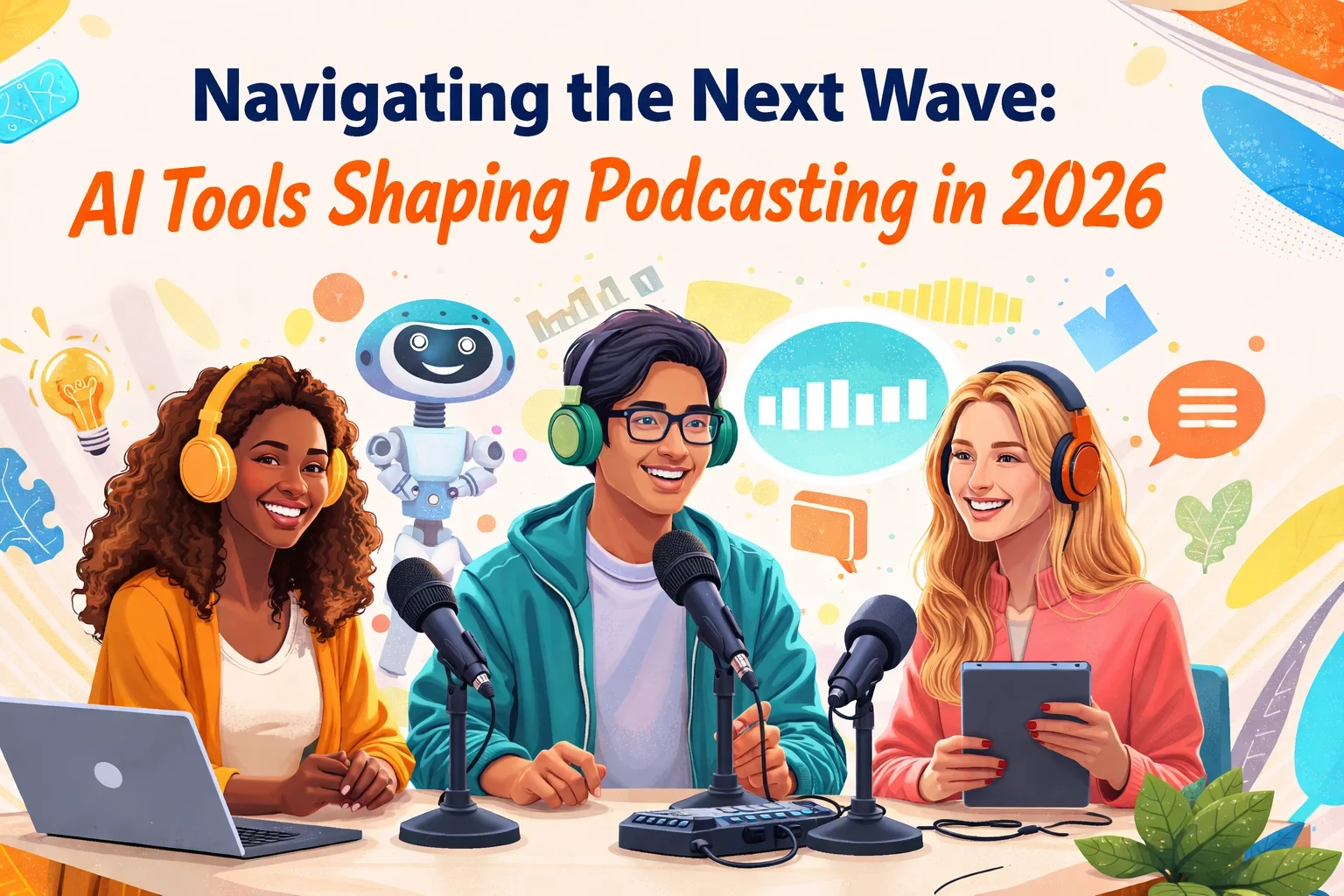
Navigating the Next Wave: AI Tools Shaping Podcasting in 2026
Let's be real for a second, if you told podcasters five years ago that AI would be editing their episodes, writing their show notes, and even cloning their voices, most of us would've laughed. 😅
But here we are in 2026, and AI isn't just knocking on the door of podcast production, it's already moved in, rearranged the furniture, and started making coffee.
The question isn't whether you should embrace AI tools anymore. The question is: which ones align with your vision, your workflow, and your growth goals?
Whether you're a seasoned podcaster looking to scale or you're just getting started, understanding how AI is reshaping the game will help you stay ahead of the curve, and honestly? It'll save you a ton of time.
Let's break it down. 🎙️
The Big Picture: Why AI Matters for Podcasters Right Now
Here's what's wild: tasks that used to take hours, editing, transcribing, creating social clips, can now be done in minutes. We're not talking about sacrificing quality either. These tools are getting smarter, faster, and more intuitive every single day.
AI is fundamentally changing the podcast ecosystem across the board:
Recording & editing
Transcription & show notes
Voice generation & dubbing
Marketing & repurposing content
The result? Creators can focus more on what actually matters, telling stories, building community, and growing their brand, instead of getting buried in the technical weeds.
If you've been feeling overwhelmed by your production workflow, this is your sign that relief is on the way. Let's dive into the tools making waves this year.
Production Powerhouses: Recording and Editing Made Easy
Riverside
If you're doing remote interviews (and let's be honest, most of us are), Riverside has become a go-to platform. It supports multitrack recordings with uncompressed audio, which means your sound quality stays crisp even when your guest is on the other side of the world.
But here's where it gets exciting: Riverside's AI features include noise reduction, automatic transcription, and, chef's kiss, automated short-clip generation for social media. You can take a 45-minute episode and have scroll-stopping clips ready to post without lifting a finger.
Descript & Podcastle
These two are like having a super-smart editing assistant on your team. Both platforms let you edit audio by editing text. Yep, you read that right. Delete a word from the transcript, and it disappears from your audio.
They also handle:
Filler word removal (goodbye, "um" and "uh")
Background noise cleanup
Audio leveling
If you've been dreading the editing process, these tools will change your life. 💡
Adobe Podcast & Veed
Adobe Podcast focuses heavily on audio enhancement, think of it as a filter for your voice that makes everything sound studio-quality, even if you recorded in your closet.
Veed is browser-based (no heavy downloads!) and offers AI noise removal, silence elimination, and even Dolby-powered audio enhancement. Plus, it has AI avatar narration if you want to experiment with different content formats.
Transcription and Show Notes: Let AI Do the Heavy Lifting
Okay, real talk, how many of us have skipped writing show notes because it felt like too much? 🙋♀️
That's where tools like Otter.ai, Rev.ai, and Castmagic come in clutch. They handle transcription with impressive accuracy and can even automatically generate show notes, timestamps, and key takeaways.
Why does this matter beyond convenience? Two words: SEO and discoverability.
Search engines can't listen to your podcast, but they can read your transcripts and show notes. Proper transcription helps your content get found, and with answer engine optimization (AEO) becoming more important, having detailed, accurate text associated with your episodes is a game-changer.
If you want to dig deeper into discoverability strategies, check out our post on 7 actionable tips for scaling your podcast in 2025 and beyond.
Voice Generation and Content at Scale
This is where things get really futuristic. 🚀
ElevenLabs
ElevenLabs is leading the charge in AI voice technology. Their platform offers:
Text-to-speech with thousands of customizable voices
Professional voice cloning (yes, you can clone your own voice)
AI dubbing in 32 languages
Imagine repurposing your English podcast into Spanish, French, or Mandarin: without re-recording a single word. For creators looking to expand globally, this is massive.
Now, a word of caution: with great power comes great responsibility. Voice cloning raises important ethical questions, and it's crucial to use these tools transparently and authentically. Your audience trusts you, so always be upfront about how you're using AI.
Workflow and Planning: Your New Command Center
Creating content is one thing. Managing it all? That's a whole different beast.
Asana
Asana has become a favorite for podcasters who need to wrangle multiple episodes, guests, and deadlines. It integrates:
Task management
AI writing assistance
Templates for episode planning
Team collaboration tools
Everything lives in one place, which means fewer missed deadlines and less chaos. If you're scaling your show or working with a team, this kind of centralized hub is essential.
Marketing and Growth: Amplify Your Reach
So you've recorded, edited, and published your episode. Now what?
Canva AI & Pixlr
Eye-catching artwork matters. Canva AI and Pixlr make it easy to create professional episodic graphics, audiograms, and promotional visuals: even if you're not a designer. Their AI features can suggest layouts, generate images, and help maintain brand consistency across platforms.
Podpage
Need a podcast website but don't want to spend weeks building one? Podpage creates beautiful, functional podcast websites in minutes. It pulls in your RSS feed automatically and keeps everything updated. Simple and effective.
Rephonic & Podscribe
For those thinking strategically about growth (and you should be!), Rephonic and Podscribe offer competitive intelligence. They track listener preferences, advertiser placements, and what's working for other shows in your niche.
Knowledge is power, friends. 💪
YouTube's Native AI Tools
Big news: YouTube is rolling out native AI tools specifically for podcasters. We're talking title and thumbnail generators, an "Ask Studio" assistant, audio-only enhancements, and video clip generators. If you're publishing video podcasts (or thinking about it), keep an eye on what YouTube releases this year.
The Human Element: AI Is a Tool - Not a Replacement
Here's the thing: and I really want you to hear this:
AI enhances your creativity. It doesn't replace it.
These tools can handle the tedious stuff so you can pour more energy into what makes your podcast yours: your voice, your perspective, your connection with listeners.
The podcasters who will thrive in 2026 and beyond are the ones who embrace AI as a collaborator while staying rooted in authenticity. Your audience can tell the difference between content that's been churned out by a robot and content that comes from a real human with something meaningful to say.
Use AI to work smarter. But never lose sight of why you started podcasting in the first place.
If you're curious about building a show that's rooted in intention and purpose, we've got a post coming later this month that dives deep into that topic. Stay tuned! 🎧
Your Next Steps
Feeling inspired? Here's how to move forward:
Audit your current workflow. Where are you spending the most time? That's probably where AI can help first.
Start small. Pick one or two tools from this list and experiment. You don't have to overhaul everything overnight.
Stay curious. The AI landscape is evolving fast. Follow industry updates and be willing to adapt.
Keep your vision front and center. Technology is a means to an end, and that end is creating impactful content that resonates.
Ready to level up your podcast production? Explore how What's Good Productions can help you grow with strategy, production, and creative direction tailored to your unique voice.
The future of podcasting is here. Let's ride this wave together. 🌊